Skip to content

IXD 102 / Individual UX project

Crave

I interviewed three Crave viewers about finding content, recommendations and playback issues.

I developed six design principles covering Home, content discovery, profiles, recommendation controls and playback reliability. Two desktop wireframes explored Home and documentary browsing.

My role
Research, synthesis, strategy and interaction design. Individual coursework.
Timeline
2025 study · October 2026 prototype refinement
Read the case study
Desktop concept2026 refinement
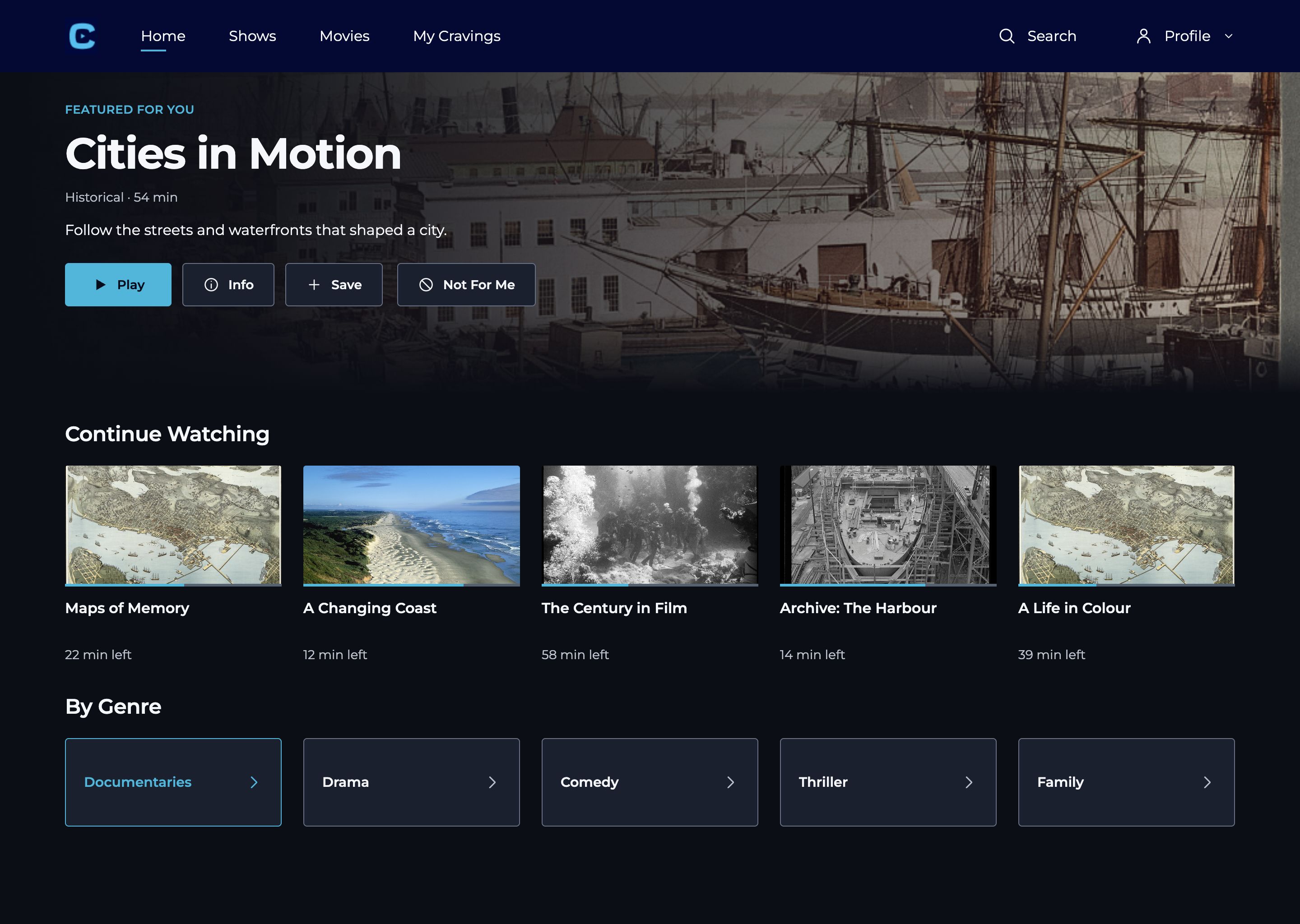
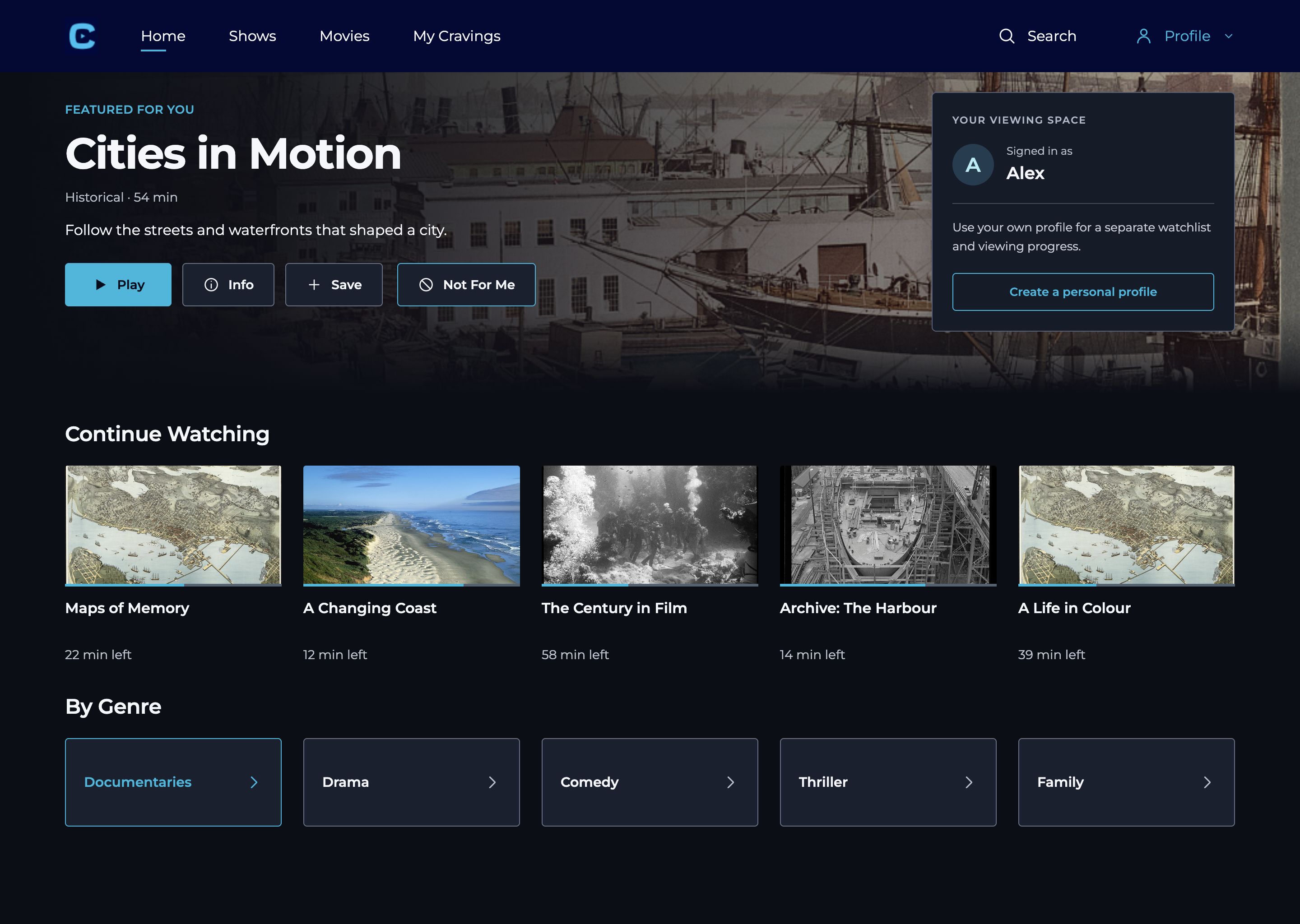
Later Crave Home concept with a featured documentary, Continue Watching and a By Genre row
Home screen from the October 2026 refinement.Enlarge

2025 study

User interviews

I began with ten assumptions and focused the interviews on discovery, personalization and technical friction. I used a 15-question guide, transcribed three interviews and grouped the accounts into needs, comments, suggestions and emotions.

The content itself still mattered: all three described their usage changing with the shows or series they were watching.

An assumption I reconsidered

I expected people to arrive with a title in mind. One interviewee usually did. The other two usually browsed without one.

Scroll across to compare all three topics

Three individual accounts, summarized from the transcripts.
ParticipantChoosing somethingRecommendation contextReturning to watch
Interview 1Usually a specific title. Categories could feel repetitive or confusing.Some recommendations fit. Shared-account use and profile uncertainty.Reported losing the viewing position after pausing and returning.
Interview 2Usually browsing. Wanted more genre choices, while finding the layout generally okay.Less relevant recommendations. Believed the family used one profile.Reported needing to refresh after time away.
Interview 3Usually browsing. Requested Historical, Current Events and True Crime documentaries.Some interest fit, but no clear explanation of the recommendation basis.Occasional TV friction. No reported phone issues.

Anonymized paraphrases from Phase 1, pp. 14–19. These three accounts informed the concept; they do not establish how common each issue is among Crave viewers.

Phase 2 strategy

Design recommendations

I developed six design principles from the study. Some became features in the wireframes, while others remained proposals for further design or technical investigation.

Simplify Home

Phase 2 / p. 9

Research basis: Participants described different starting intentions and problems with repetitive or confusing categories.

Recommendation: Use fewer, clearer sections, remove repeated content placements, improve the hierarchy and keep Continue Watching prominent.

Home wireframe

Continue Watching and By Genre are visible in the original Home layout. A reduction in overload was not measured.

Use more specific categories

Phase 2 / p. 10

Research basis: Participants wanted clearer genre choices; one requested specific documentary subjects.

Recommendation: Add subgenres and useful filters, avoid duplicate listings, offer an editorial “Hot this month” category and let viewers pin preferred categories.

Wireframe and selected prototype states

Documentary subjects appear in the wireframe. The later prototype develops subject and length selection. Editorial and pinning features remain proposals.

Make profile setup more visible

Phase 2 / p. 11

Research basis: Two interviewees were unsure about, or did not recognize, individual profile options.

Recommendation: Prompt profile creation during onboarding, make Add Profile easier to find, collect favourite genres or shows, and keep viewing histories separate.

Home wireframe cues

The layout includes a profile control, signed-in context and a setup reminder. Guided setup and preference checks were not developed into complete flows.

Offer more ways to browse

Phase 2 / p. 12

Research basis: Two interviewees usually browsed without a particular title in mind.

Recommendation: Explore curated collections, editorial playlists, a shuffle or “Surprise Me” option, mood filters and custom saved lists.

Genre route shown; other ideas proposed

The Home wireframe provides a By Genre route. Collections, shuffle, mood filters and custom lists remained strategy proposals, not tested features.

Improve playback reliability

Phase 2 / p. 13

Research basis: Accounts included lost viewing positions, refreshing after time away and occasional TV friction.

Recommendation: Preserve playback position, improve resuming after inactivity, review buffering and device consistency, and add a Still Watching check.

Technical investigation proposed

Playback was outside the wireframes and browsing prototype. The interviews did not establish device benchmarks or comparative performance.

Explain recommendations and add controls

Phase 2 / p. 14

Research basis: Recommendation relevance was mixed, and the viewing context or recommendation basis was not always clear.

Recommendation: Explain why content is suggested, allow preference overrides or resets, offer Don’t Recommend This, adjust category visibility and clarify streaming-quality information.

Feedback cue shown; settings proposed

The Home wireframe includes Not For Me. Recommendation explanations, reset settings and quality indicators remained proposals.

Source: Phase 2, “Design Principles and Recommendations,” pp. 9–14. The recommendations include design proposals as well as responses directly supported by interview accounts. Their effectiveness was not tested.

Interview evidence

Select an area to see the accounts, interpretation and design response behind these recommendations.

Interview evidence / Paraphrased

Interview 1
Usually arrives for a specific show.
Phase 1 p. 14 · 01:15
Interviews 2 and 3
Usually browse without a particular title in mind.
Phase 1 p. 16 · 00:44; p. 18 · 01:37

Knowing a title does not necessarily mean resuming something already watched.

Insight

Different browsing intentions

The Home concept needed to support both patterns described in the interviews: finding a specific title and browsing for something to watch.

Recommendation
Retain Search and Continue Watching, while making genre browsing visible.
Design response
The original Home wireframe includes direct access, a Continue Watching row and a By Genre entry.
Inspect the original Home wireframe

Interview evidence / Paraphrased

Interview 1
Some categories feel confusing or repetitive.
Phase 1 p. 14 · 03:06
Interview 2
Wants more comprehensive genre choices.
Phase 1 p. 18 · 11:24
Interview 3
Names Historical, Current Events and True Crime as useful documentary subjects.
Phase 1 p. 19 · 07:22

A difference worth retaining: Interview 2 also described the overall layout as generally okay (p. 17, 02:38).

Theme / Category choices

More specific documentary categories

The requested subjects gave me a concrete way to organize documentaries for people browsing without a title in mind.

Recommendation
Add subject-level choices within Documentaries.
Design response
Historical, Current Events and True Crime appear in the original documentary wireframe. The later prototype includes selected subjects, length filtering and a clear action.
Boundary
Nature, Biographical and length are design proposals. Their usefulness has not been tested.

Interview evidence / Paraphrased

Interviews 1 and 2
Are unsure about, or do not recognize, individual profile options.
Phase 1 p. 16 · 08:40 and 01:59
Interview 3
Cannot see an explicit basis for recommendations.
Phase 1 p. 18 · 03:22

Recommendation relevance was mixed. These accounts do not establish that the recommendation algorithm was inaccurate.

Insight

Profile awareness and recommendation context

The interviews supported making profiles and recommendation explanations clearer. They did not establish a problem with the algorithm itself.

Recommendation
Surface profile choice and setup, explain recommendation context, and offer feedback controls.
Design response
The Home wireframe contains a profile control, setup reminder and Not For Me cue.
Boundary
These are wireframe cues. A complete profile or feedback flow, and any effect on recommendation quality, remain unverified.
Inspect the profile cues

Interview evidence / Paraphrased

Interview 1
Loses the viewing position after pausing and returning.
Phase 1 p. 14 · 03:56
Interview 2
Needs a refresh after being away.
Phase 1 p. 17 · 03:44
Interview 3
Reports occasional TV problems, with no phone issues.
Phase 1 p. 19 · 06:21–06:32

Losing a position and refreshing a stream are different failure modes. The interviews were not controlled device tests.

Insight

Playback recovery after interruptions

The reported problems included lost viewing positions and refreshing after inactivity, as well as occasional TV issues.

Recommendation
Preserve viewing position, investigate resume behaviour and review autoplay checks.
Design response
This remained a strategy and engineering recommendation. Playback was outside the browsing prototype’s scope.
Next inquiry
Reproduce the reported pause, refresh and TV issues with engineering, then evaluate recovery by device and context.

This evidence reader reconstructs the research-to-decision links from the existing notes and transcripts. It does not represent an additional interview or synthesis session.

2025 coursework

Home and documentary wireframes

The Home wireframe brings together the layout, profile-awareness and feedback recommendations. The documentary wireframe explores more specific categories and proposed filters.

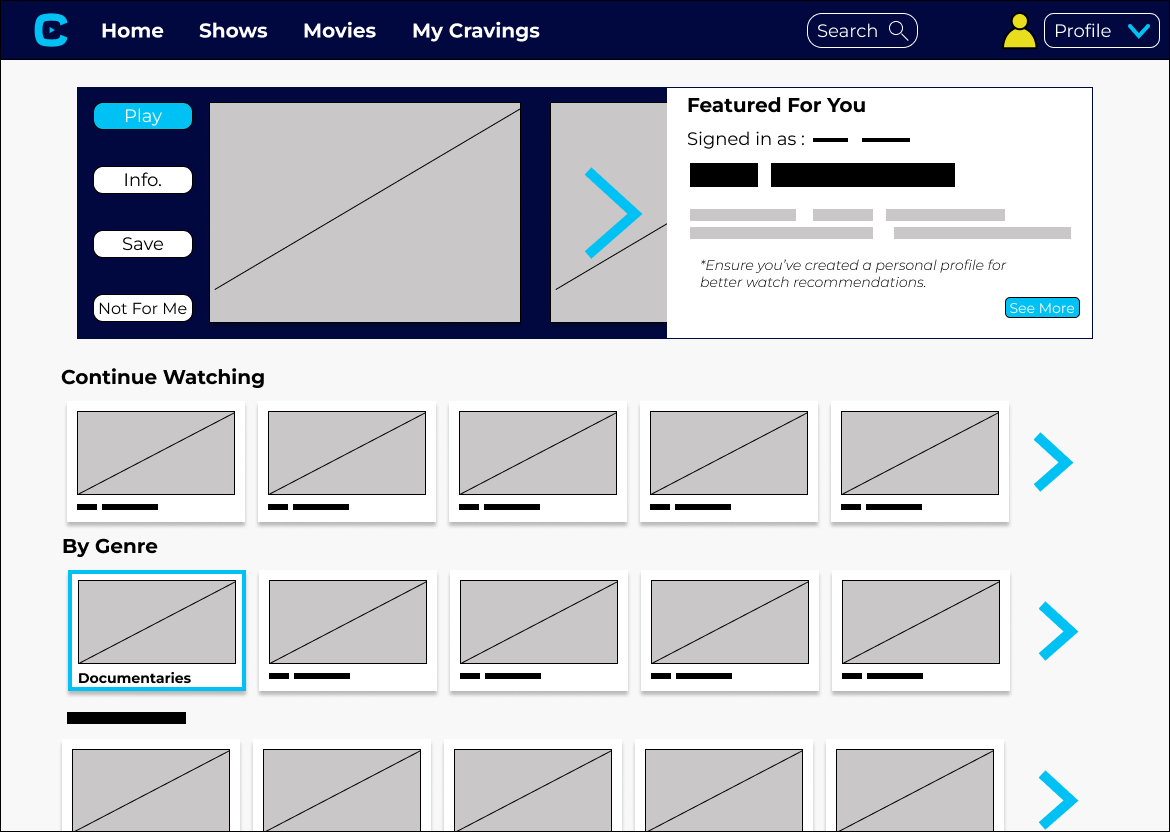
Home wireframe / 2025Phase 3 / p. 26
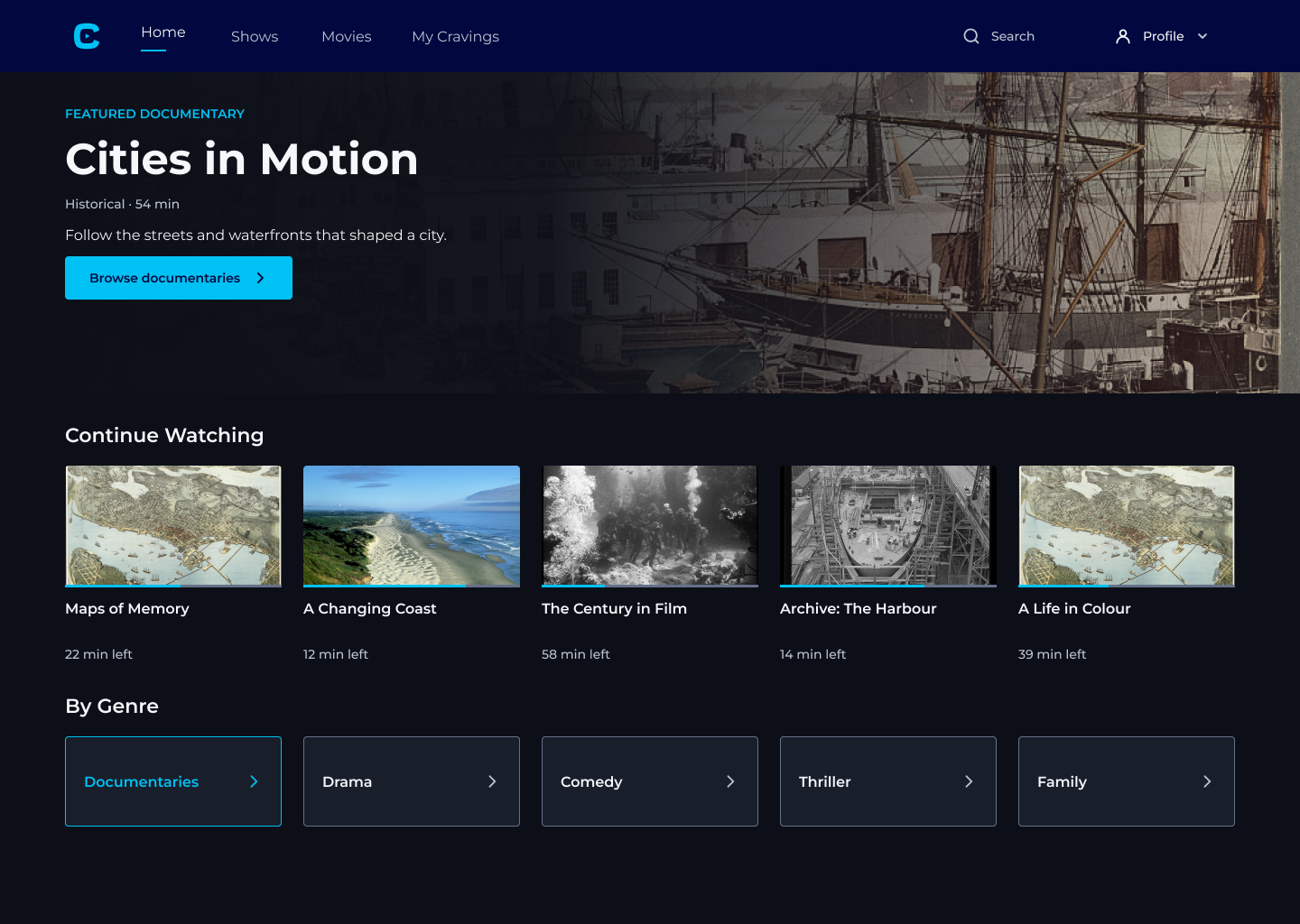
Original Home wireframe with Continue Watching, By Genre, a Profile control, signed-in context, a personal-profile reminder and a Not For Me action
Original Home concept, including profile and feedback cues.Enlarge

Home

From the interviewsOne interviewee usually arrived for a particular show. Two usually browsed without a specific title in mind.
Phase 1: pp. 14, 16 and 18.

Content hierarchy
Search, Continue Watching and By Genre support different starting intentions.
Profile awareness
The Profile control, signed-in context and personal-profile reminder make the account context more visible.
Feedback
Not For Me gives the recommendation-control proposal a visible place in the layout.

These are wireframe cues. The full profile setup, feedback and recommendation-reset flows were not developed or tested.

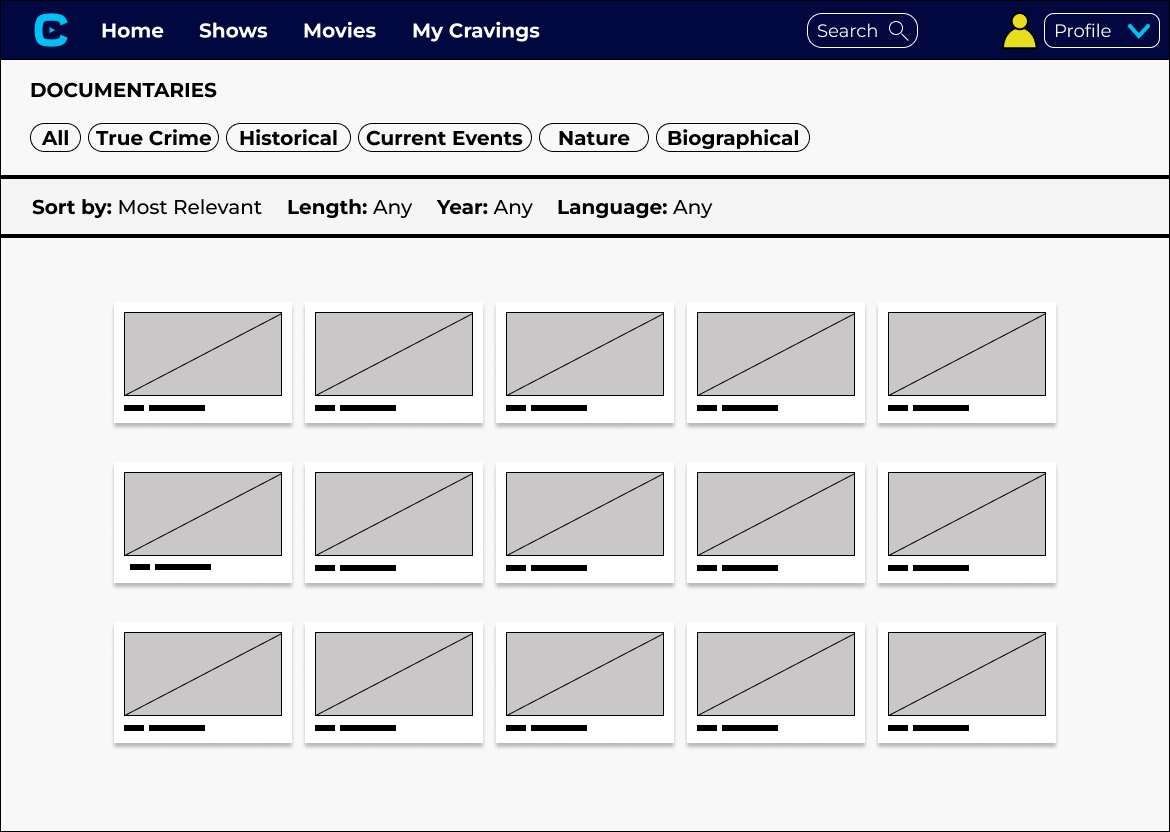
Documentary wireframe / 2025Phase 3 / p. 27
Original documentary wireframe with All, True Crime, Historical, Current Events, Nature and Biographical, followed by proposed sort and filter controls
Original artwork and typography, unchanged.Enlarge

Documentaries

From the interviewsA participant requested Historical, Current Events and True Crime. I used those subjects to make documentary choices more specific.
Phase 1: p. 19.

Subject categories
Historical, Current Events and True Crime connect directly to a participant’s requested subjects.
Unfiltered browsing
All preserves a way to browse across the whole documentary list.
Proposed filters
Length, year and language are proposed refinements. Interview 2’s concern about language availability is not resolved by adding a Language control.

The journey and task flow were synthesized models. No original usability study of these wireframes was supplied.

2026 refinement

Prototype refinement

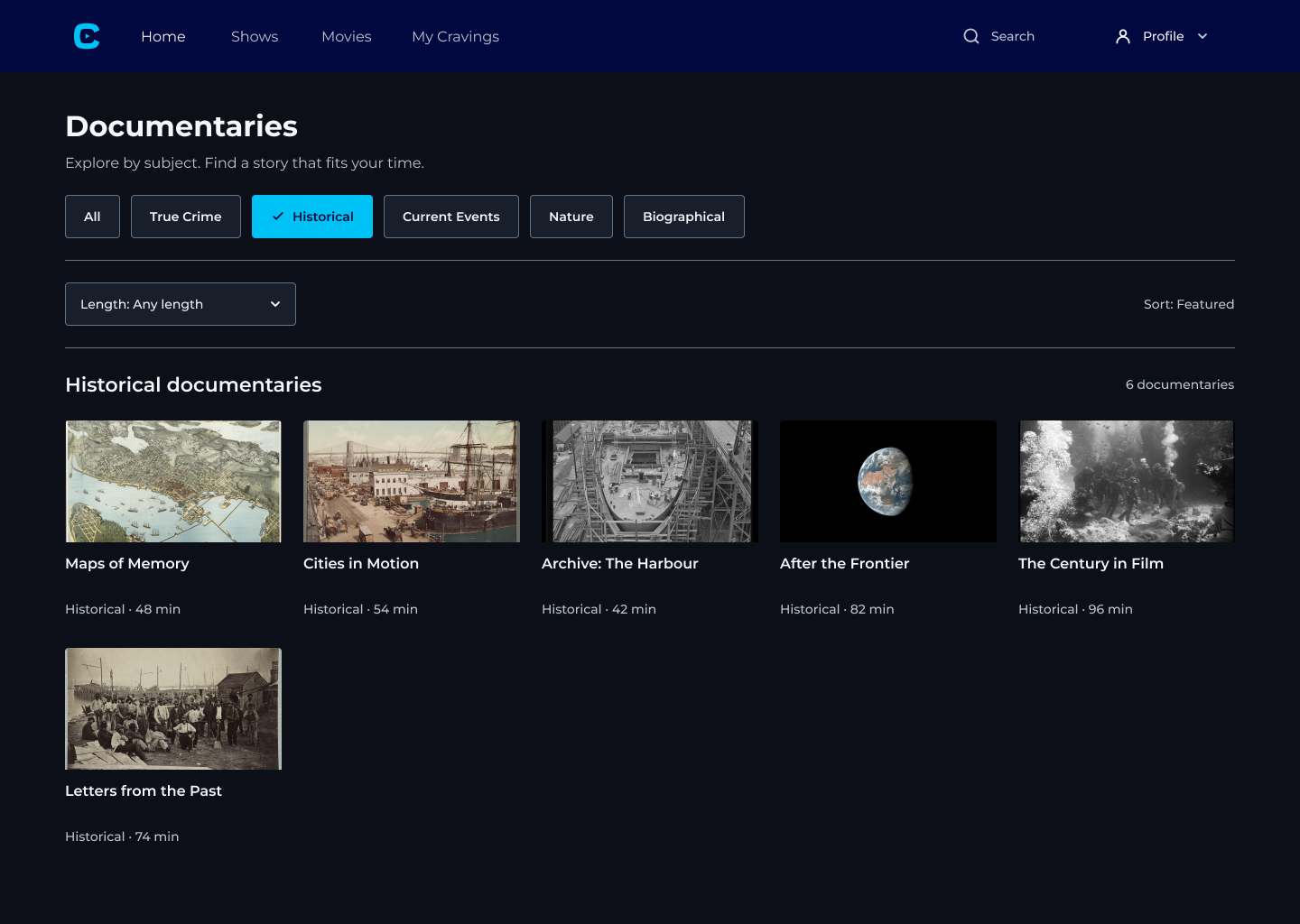
I developed the documentary wireframe into a separate desktop Figma prototype with subject selection, length filtering and a clear action. The additional Home mockups below bring Continue Watching, By Genre, profile context and Not For Me into the same visual system.

The Home screens are later visual studies. Complete profile setup, feedback behaviour, recommendation explanations, preference-reset controls and playback improvements remain proposals. Length remains a design hypothesis.

Historical selected in the later prototype, with any length and six illustrative documentary titles
Historical selected · Any length · 6 illustrative titlesEnlarge this state

Programme titles, runtimes and viewing progress are illustrative. The change from six titles to three demonstrates a filter state; it is not a measured discovery improvement or a current Crave catalogue.

Try the connected Figma prototype

Additional visual studies / November 2026

Home mockups

These two views develop the original Home wireframe’s content hierarchy, signed-in context and feedback cue. They use the documentary refinement’s typography, colour and image treatment. Alex is an illustrative profile; the screens do not demonstrate a working profile or recommendation system.

Project status

Outcome and next steps

The coursework produced a research-based strategy and two wireframes. The later work develops documentary browsing and translates the Home layout into high-fidelity visual studies. Profile setup, feedback behaviour and playback recovery still need separate work.

2025 coursework
I completed the three interviews, synthesis, strategy, six design principles, journey and task models, and two desktop wireframes independently.
2026 refinement
A separate Figma documentary-browsing prototype. Functional checks covered its links, subject and length persistence, clearing, menu dismissal and scrolling. The additional November Home mockups are visual studies; their profile and feedback flows have not been implemented or tested.
What I would test next
Give viewers a documentary subject, then check whether they can interpret the labels, find a relevant option and understand the active refinement. Profile awareness and playback recovery need separate evaluation.

No post-design usability study, recommendation-system test or measured retention outcome is available. The prototype covers desktop browsing; playback, title details, complete search/profile flows and mobile behaviour remain outside its scope.

Sources, dates and assistance

The original work is an individual IXD 102 course study. Phase 3 is the final submission. Phase 1 was exported on 11 November 2025 and Phase 3 on 10 December 2025; these establish the submission period, not exact interview dates.

Source documents: “Ian Johnstone - IXD 102 Crave phase 1(1).pdf,” “Ian Johnstone-Crave phase 2pdf.pdf” and “Ian Johnstone-IXD 102 Phase 3.pdf.” The complete review covered their 65 pages and all four original Figma pages. Public findings use anonymized paraphrases; raw transcripts remain private.

The high-fidelity refinement (30 October 2026), research-led deck (31 October 2026), additional Home visual studies (5 November 2026) and this portfolio page were developed with Codex assistance. The original submission remains unchanged. This is an independent course concept, with no claim of commission, approval or implementation by Crave.

Archival images in the illustrative programme artwork come from the Library of Congress and NASA. Full image credits are on the deck’s final slide. Linked Figma files may require access.

Original artwork

Crave Home concept